
Replenishment in Fashion Retail: The 6 Maturity Levels Explained
Ask a merchandising team how they handle replenishment and most will say something like: “We have an automated system. It factors in demand. It’s pretty sophisticated.”
Ask them to walk you through it and a different picture tends to emerge.
The real version tends to involve a lot of spreadsheet checks, a few manual overrides and parameters that were set at the start of last season and remain untouched to this day. It’s not that the team is doing anything wrong, but because that’s how replenishment tends to work at most fashion retailers. That, and the fact that nobody’s ever laid out what “more sophisticated” actually looks like.
That’s what this post is for.
What does replenishment mean in fashion retail?
Replenishment in retail is the process of moving inventory from a warehouse or distribution center to stores, getting the right product to the right location before it runs out.
In fashion, that’s harder than it sounds, because products have short lifecycles, demand shifts week to week, and size that sells out in one store might be gathering dust in another three kilometers away.
Done well, replenishment is almost invisible: shelves stay stocked, sell-through stays healthy and the team spends much less of their week firefighting. Done badly, it results in stockouts on best sellers and excess stock on everything else.
How sophisticated that process is and how much it costs you when it isn’t depends entirely on at which of these six operating levels your team works.
The 6 levels of replenishment in fashion retail
Level 1. Manual replenishment
This is where most retailers start and more than a few never really leave. The team builds replenishment orders by hand: store by store, SKU by SKU, pulling data from whatever systems they have access to and making judgment calls based on experience.
It works, up to a point. Experienced merchandisers develop good instincts, but the process typically takes two to three days. That means that by the time orders are placed, the data behind them is already stale. It doesn’t scale either. Every new store, every new product line, every new season adds to the workload without adding to the team.
Level 2. Static auto 1:1
Sell one, send one. The system automates the basic trigger: when a unit leaves the store, one is queued to replace it.
It’s faster than manual and removes a lot of the administrative burden, but it treats every store as if it were the same: same demand pattern, same capacity, same rate of sale. A city-center flagship and a smaller regional location get the same logic applied to them.
This creates a problem that compounds over time. Stores that sell well keep getting restocked; stores that don’t, don’t. This only reinforces the pattern rather than corrects it. Retailers end up with a system that’s reacting to yesterday’s results and not true inventory management.
Level 3. Static min / max
This is a step forward. Instead of a simple 1:1 trigger, you define a floor and a ceiling for each SKU at each location. When stock drops to the minimum, you replenish up to the maximum.
This gives the system some awareness of store context: a larger store might have a higher max, a slower-moving category might have a lower floor, which is an important nuance.
The limitation is in the word “static.” Those parameters get set (usually at the start of a season, or when a new product is introduced) and they rarely get updated. Stores change. Consumer behavior shifts mid-season. The product moves through its lifecycle, and the rules stay the same regardless.
When did you last update your min/max parameters? For most teams, the sincere answer is “longer ago than it should have been.”
Level 4. Dynamic min / max
This is where the system starts doing more of the thinking. Rather than fixed thresholds, an intelligent system adjusts min and max values automatically based on real demand signals. A store experiencing a sales spike gets a higher ceiling. A location slowing down gets recalibrated accordingly.
It’s a significant improvement, because the system is at least responsive to what’s happening, rather than locked into decisions made months ago.
But it’s still operating within a threshold framework. The question the system is asking is “are we above or below the line?” That’s a reasonable question, though not the most useful, which would be “given everything we know, what’s the optimal quantity to send to each store right now?”
Dynamic min/max gets you closer, but not quite all the way.
Level 5. Dynamic auto: forecast-based
This is where replenishment starts to feel truly intelligent. The system moves beyond thresholds entirely and generates a demand forecast for each SKU at each store, projecting how much is likely to sell over the replenishment horizon, accounting for seasonality and average rate of sale and calculating orders accordingly.
Most sophisticated retailers are somewhere around this level and it’s a real step up. The problem is that “average sales” and “seasonality” are broad brushes. They miss the things that actually differentiate one store from another such as which cluster it belongs to and what the warehouse availability looks like across the whole network.
Level 6. Dynamic auto: ML-based
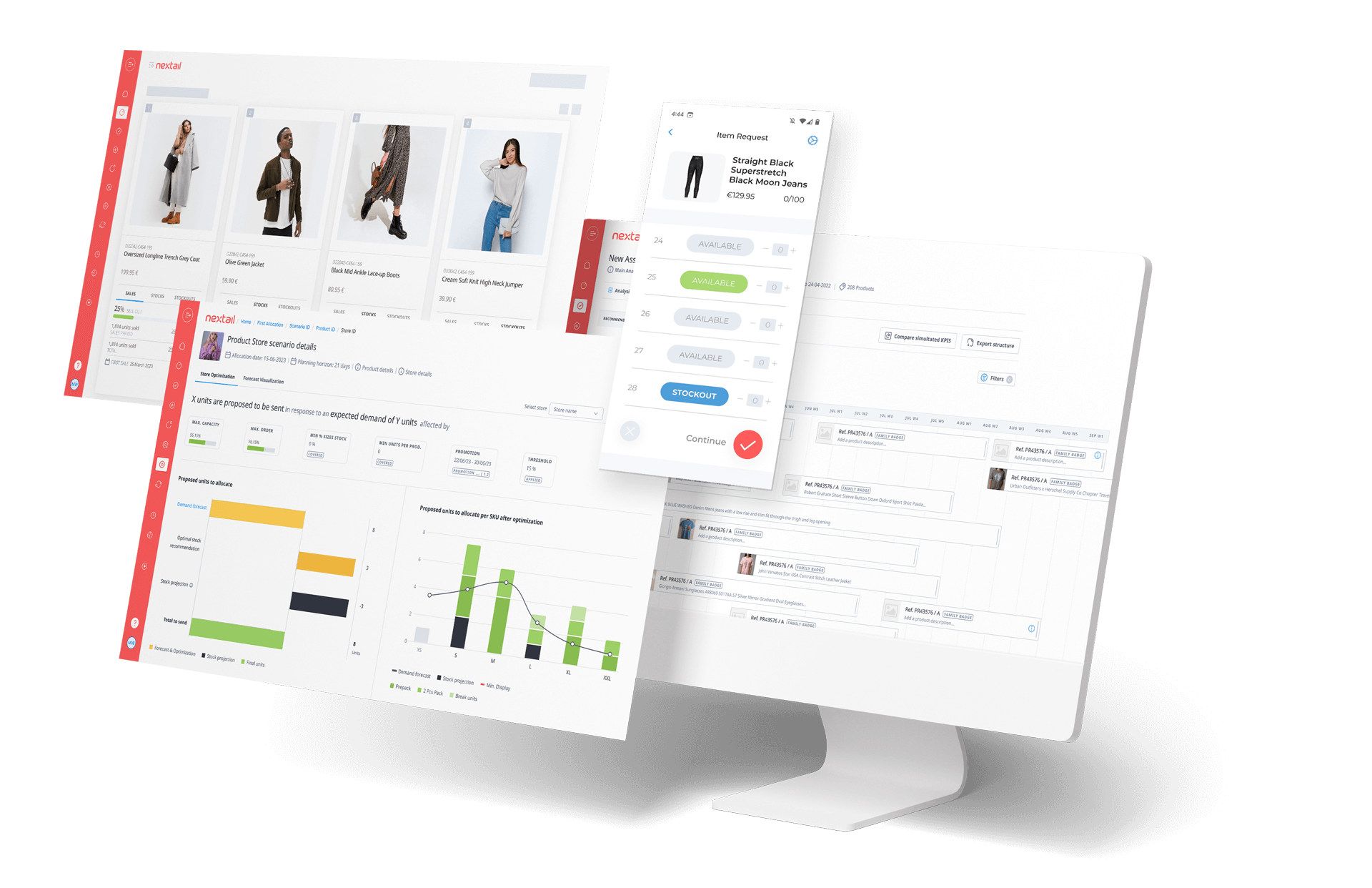
This approach that Nextail is built around. Machine learning models factor in demand signals, store clusters and warehouse scarcity, simultaneously, across every SKU and every store, recalculated continuously. This is something Gartner has recognized in their 2026 Market Guide for Retail Forecasting Allocation and Replenishment Solutions for short-life cycle products (e.g. fashion), naming Nextail a Representative Vendor for the third consecutive year.
The system doesn’t just ask what each store is likely to sell. It’s also asking where each available unit in the warehouse will have the highest probability of being sold, which are two very different questions, especially when taken to scale.
The outcomes: stockouts get delayed, full-price sell-through improves, and the team gets time back to spend on decisions that require, and benefit from, human judgment.
This is the level where replenishment stops being a logistics problem and becomes a commercial advantage. If you want to dig into what that looks like in practice, our white paper on agile merchandising covers it.
Where does your team actually sit?
Most teams think they’re at Level 4. They’re usually at Level 2 where manual interventions accumulate and become normal, workarounds get built into the process, and the system feels more capable than it is because your team is quietly compensating for its gaps every day.
The first step to getting to the next level is being honest about where you actually are. Once you know that, the path forward gets a lot clearer. If you’d like to explore Level 6 of Replenishment, please email us directly at info@nextail.co